
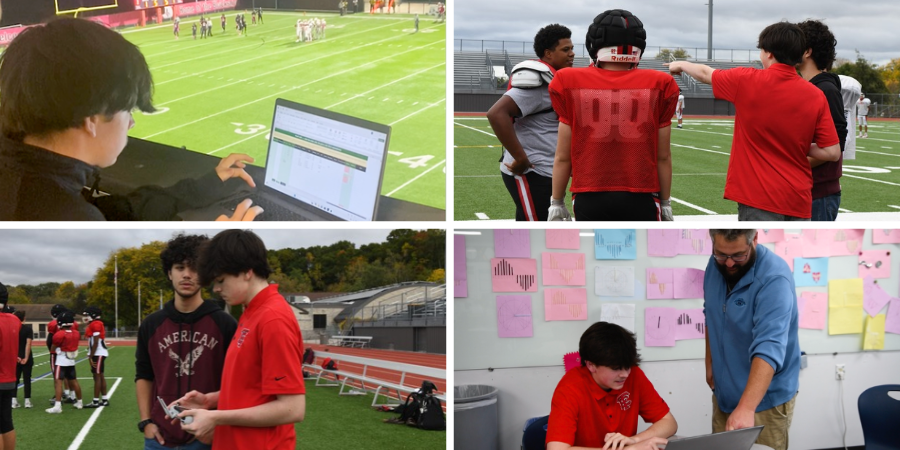
When the Wauwatosa East High School football team was trailing crosstown rival Wauwatosa West by two touchdowns at the Sept. 18 “Battle for Tosa” rivalry game, a group of students off the field helped the Red Raiders fight their way back into the game.
Working from the press box, East junior Henry Berthold and other members of East’s new student-led football analytics team had been meticulously tracking plays, downs, and yardage throughout the game — just as they had all season. Berthold identified two sets of plays that had been particularly successful, and, at halftime, he shared his findings with the coaches.
“During the second half, we used those much more frequently, allowing us to come back from a two-score deficit, allowing it to be a much more competitive game than it would have been,” Berthold said.
Although East narrowly lost the game 22-21, the Battle for Tosa demonstrated the analytics team’s major impact. Founded by head JV football coach and assistant offensive line coach Zack Beckman, the team uses statistics and data analysis to help coaches make more informed in-game decisions while giving students valuable real-world experience in the growing field of sports analytics.
“As far as I’m aware, no other schools [in the area] have a program like this,” said Beckman, who is also a special education teacher supporting East’s math department. “It gives us a huge competitive advantage because our coaches know with 100% accuracy what plays are working and what plays are not working. … You’re not going to let your biases as a coach when you’re play-calling influence what is actually happening on the field.”
Bringing college-level opportunities to Tosa East
Beckman felt compelled to introduce sports analytics opportunities at East after visiting multiple college football teams, including Northwestern University, where he observed how undergraduate students were highly involved in helping athletic departments collect data, film practices, and analyze in-game performance.
By bringing similar experiences to East, Beckman hopes to give students a unique head start on developing skills that could help them later land internship positions with university athletic departments.
Berthold was one of the first students Beckman approached about joining the analytics team last spring. Berthold has always gravitated toward math, and, as a shot put and discus thrower alongside many of East’s football players, he welcomed the opportunity to become more involved with the team.
Throughout the season, Berthold and his fellow student-analysts attended three football practices each week, JV games on Thursdays, and varsity games on Fridays. Members of the JV team also assisted in filming practices and games, including capturing drone footage.
“Varsity games are where I really do most of my job,” Berthold said. “I’ll be up in the press box with … our coaches, and I’ll be on a giant spreadsheet writing down plays, downs, yards, and communicate that with coaches during a game, if it’s something pressing, or usually during halftime.”
By documenting each play, the students provide coaches with detailed information about which strategies are working and which may need to be adjusted.
“Sometimes, [coaches] don’t know what specifically worked well … unless a touchdown or major play was brought out of it,” Berthold said. “Having people up in the press box and working with coaches allows for better records of what we do, allowing coaches to better think out their processes when trying to decide something new to run.”
While the analytics team works with spreadsheets and statistics, Beckman emphasized that the math itself is relatively straightforward — roughly equivalent to eighth-grade level.
“Being able to communicate effectively with decision-makers is the skill they’re really working on,” he said. “Those 21st-century skills of analyzing data and communicating that accurately to people are the most important thing.”
Building skills for the future
Beyond supporting gameday success, analytics team students are developing valuable skills used in business, technology, artificial intelligence, and other high-demand career fields, Beckman said. Just as football players improve their techniques throughout the season, so do the students working behind the scenes.
Students on the analytics team “are getting better every single week and giving us better and more accurate information as the season progresses,” Beckman said. “I’m really proud of them. I think they’re going to do a lot of really cool things when they graduate.”
For Berthold, the experience has inspired him to consider new career possibilities. Before joining the analytics team, he primarily envisioned a future in math but was unsure of how he’d apply his favorite subject to a career.
“I’ve definitely taken a lot bigger of an interest in statistics and analyzing data,” he said. “There are so many different fields you can work in, one of which being sports.”
Berthold hopes to attend a university like Notre Dame or Marquette, where he could put his analytical skills to work for a major college athletic program. That way, he said, he can participate in sports at one of the highest levels without needing to be “one of the most athletic there.”
[Click here to watch a video interview with the football analytics team].